
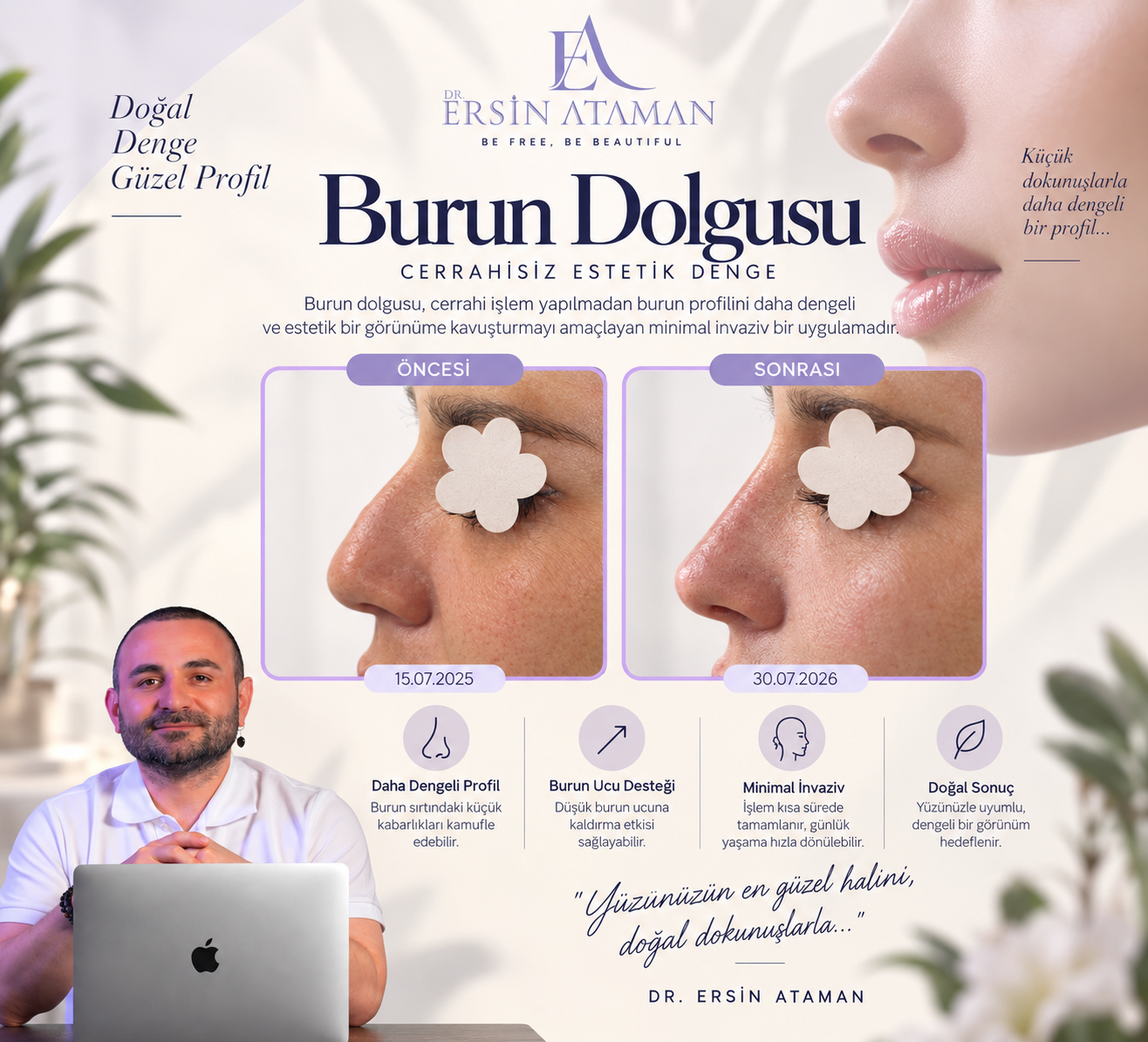
Short answer: Natural profile balance with nose filler is planned by assessing the nasal root, bridge, tip, lips and chin as parts of the same facial profile. The aim is not simply to add volume, but—when anatomy is suitable—to make limited, controlled contour changes that create a more balanced transition.
What does a natural nose-filler profile mean?
A natural result does not mean creating a perfectly straight bridge or a strongly rotated tip in every patient. Bone and cartilage structure, skin thickness, asymmetry and facial proportions differ. Planning should therefore be individualized using frontal, profile and oblique assessment.
Which areas affect profile balance?
The nose should not always be assessed in isolation. The forehead-to-nose transition, radix, bridge, tip projection, nasolabial angle, lips and chin all influence profile perception. For example, when chin projection is limited, changing only the nose may not create the expected overall balance.
Can small bridge irregularities be camouflaged?
In suitable anatomy, selected depressions or minor contour irregularities may be camouflaged by creating smoother transitions. Filler does not remove tissue; it adds volume. Major structural deformity, functional problems or situations in which additional volume would be inappropriate may require surgical assessment instead.
How is tip support considered?
The goal and anatomical limits vary between patients. Existing tip projection and rotation, columellar anatomy and vascular considerations should be assessed together. Excessive product can compromise natural proportions and is also inappropriate in a vascularly sensitive region such as the nose.
Does less filler always look more natural?
Natural appearance is not determined by millilitres alone. Injection plane, placement, product characteristics and existing anatomy are equally important. A very small correction may be enough in one patient, while another anatomy may not be suitable for filler at all.
Is nose filler an alternative to rhinoplasty?
Not in every case. Filler cannot physically reduce the nose, surgically alter bone or cartilage, or treat breathing problems. In selected patients it can provide temporary contour and profile changes. The appropriate approach should be decided after examination.
Why is safety especially important?
The nose requires particular caution because of its vascular anatomy. Rare but serious dermal-filler complications include vascular occlusion, tissue injury and vision-related complications. Unusual severe pain, white-grey-blue skin discoloration or visual changes during or after treatment require urgent medical assessment.
Nose filler assessment in Bursa
At Dr. Ersin Ataman’s clinic in Nilüfer, Bursa, planning considers the profile, nasal anatomy, facial proportions and the patient’s goal together. See nose filler in Bursa for treatment information and the general nose filler guide for an overview.
Frequently asked questions
Does nose filler make the nose smaller?
No. Filler adds volume. Strategic contour changes may create a more balanced visual impression from selected angles, but the physical size is not reduced.
Can nose filler lift the tip?
Selected anatomies may allow limited support to the appearance of the tip, but this depends on anatomy and is not equivalent to surgical change.
Is the result permanent?
Hyaluronic-acid nose fillers are temporary. Duration varies according to product, treatment area and individual factors.
Is everyone suitable?
No. Previous surgery, existing filler, anatomy, skin and circulation-related factors and the intended goal all need assessment.
This content is for general information and does not replace individual examination or medical assessment.